Overview of Surveying in Civil Engineering
Surveying is a fundamental branch of civil engineering that involves the science and art of determining the relative positions of points on, above, or beneath the Earth's surface. It primarily measures distances, angles, elevations, and directions to create accurate maps, plans, and data for designing and constructing infrastructure projects.
The primary objective is to establish the three-dimensional relationships between different points on the ground, enabling engineers to plan, design, and execute projects like roads, bridges, buildings, dams, and tunnels with precision. Surveying ensures that structures are built in the correct location, at the right elevation, and aligned properly, minimizing errors and costs.
Importance and Applications
- Site Selection and Planning — Determines topography, soil conditions, and boundaries before construction begins.
- Construction Layout — Provides staking points for foundations, alignments, and grades during building.
- Mapping and Documentation — Creates topographic maps, contour plans, and as-built records.
- Monitoring — Tracks deformations in structures like dams or bridges.
- Legal and Boundary Purposes — Establishes property lines and resolves disputes.
Without accurate surveying, projects could face issues like misalignment, flooding risks, or legal challenges.
Principles of Surveying
Surveying follows key principles for accuracy:
- Work from whole to part — Establish control points over the entire area first, then fill in details.
- Use consistent and independent checks to detect errors.
- Maintain high precision in measurements, especially for primary control networks.
Classification of Surveying
Surveying is broadly classified into two main categories based on the Earth's curvature consideration:
- Plane Surveying Assumes the Earth's surface is flat (ignores curvature). Used for small areas (<250 km²). Most civil engineering projects fall under this.
- Geodetic Surveying Accounts for the Earth's spherical shape. Used for large-scale surveys like national mapping or long-distance projects.
Types of Surveying Based on Purpose/Method
| Type | Description | Common Applications |
|---|---|---|
| Topographic Survey | Maps natural and man-made features, including contours, elevations, trees, buildings, and utilities. | Site planning, road design, flood risk assessment. |
| Land/Boundary Survey | Determines property lines, corners, and legal boundaries. | Real estate transactions, subdivisions, fencing. |
| Construction Survey | Layout and staking for building structures; includes as-built surveys post-construction. | Building foundations, roads, bridges, tunnels. |
| Hydrographic Survey | Maps underwater features like riverbeds, lakes, or seabeds (depths, contours). | Ports, dams, irrigation canals, navigation. |
| Aerial/Drone Survey | Uses aircraft or drones with photogrammetry/LiDAR for large-area mapping. | Rapid topographic mapping, mining, large infrastructure. |
| Route Survey | For linear projects like highways, railways, pipelines (alignment and profiles). | Transportation corridors. |
Traditional methods include:
- Chain Surveying → Uses chains/tapes for distance measurement in triangulated networks (simple, for small flat areas).
- Plane Table Surveying → Graphical method where mapping is done directly in the field on a table.
- Traverse Surveying → Series of connected lines with measured lengths and angles.
Here are examples of traditional plane table surveying setups:

Instruments Used in Surveying
Traditional to modern instruments have evolved for greater accuracy and efficiency:
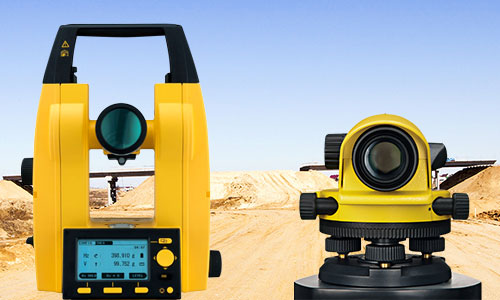
- Leveling Instruments — Dumpy level, auto level for elevation differences.
- Angle Measurement — Theodolite (optical), Total Station (electronic theodolite + EDM).
- Distance Measurement — Chains/tapes (old), Electronic Distance Meter (EDM).
- Modern Tools — Total Station (combines angle, distance, and data recording), GPS/GNSS receivers, Drones with cameras/LiDAR.
Examples of key instruments:

Modern drone and GPS-based surveying for faster, large-scale data collection:



In summary, surveying forms the backbone of civil engineering by providing essential spatial data. Advances in technology like GPS and drones have made it more efficient and accurate, reducing time and errors in projects.