Soil Hydrology in Soil Mechanics: An Overview
Soil hydrology, often referred to as soil water dynamics or hydraulic behavior of soils in the context of soil mechanics, deals with the occurrence, distribution, movement, and properties of water in soil pores. It is a critical aspect of geotechnical engineering, influencing soil strength, deformation, stability, and interaction with structures. Soil hydrology bridges saturated and unsaturated conditions, incorporating principles from Darcy's law, capillary action, and seepage theory. These concepts are essential for analyzing consolidation, seepage forces, slope stability, and foundation drainage.
Below is a detailed, neutral explanation of key components.
1. Soil Water Types and States
Soil water exists in different forms based on its location and energy state:
- Hygroscopic Water: Thin film adsorbed on particle surfaces due to molecular forces; unavailable for plant use or flow.
- Capillary Water: Held by surface tension in pores; responsible for capillary rise.
- Gravitational Water: Free water that drains under gravity.
- Soil Saturation States:
- Saturated: All voids filled with water.
- Unsaturated: Voids contain water and air; common near the surface.
- Dry: Minimal water content.
Capillary rise occurs in fine-grained soils due to meniscus formation in pores, drawing water upward against gravity.
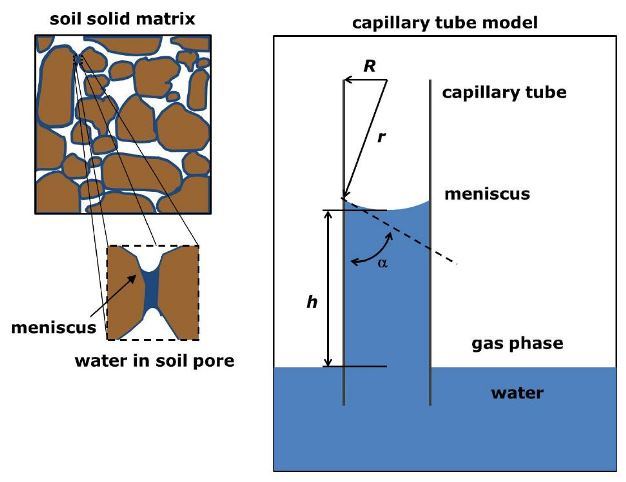

The height of capillary rise is approximated by:
where is surface tension, is contact angle, is unit weight of water, and is pore diameter (higher in clays, up to meters; negligible in gravels).
2. Permeability and Hydraulic Conductivity
Permeability measures the ease with which water flows through soil. The key parameter is hydraulic conductivity (or coefficient of permeability), with units of velocity (m/s or cm/s).
Typical values vary widely by soil type:

- Clean gravel: to m/s (highly permeable)
- Sands: to m/s
- Silts: to m/s
- Clays: m/s (low permeability)
Factors affecting : Void ratio, particle size distribution, soil structure, viscosity (temperature-dependent), and saturation degree (lower in unsaturated soils).
3. Darcy's Law
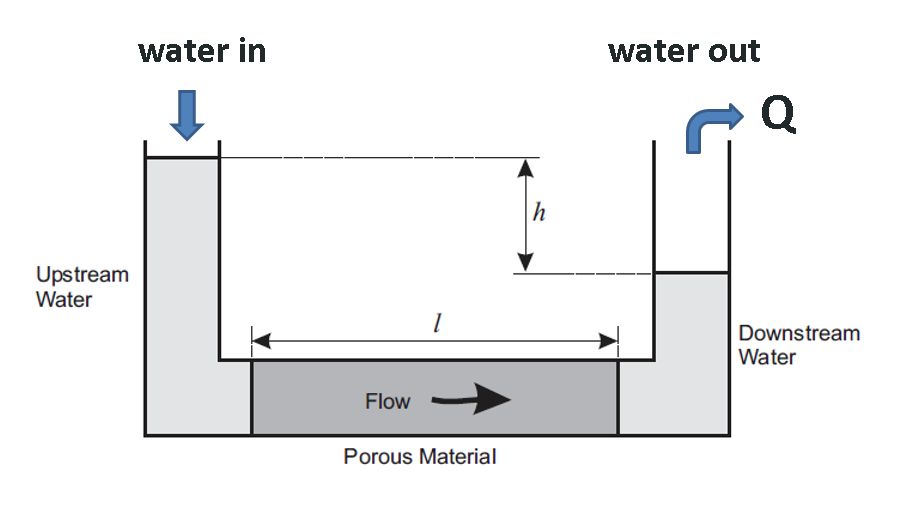
Established by Henry Darcy in 1856, this is the fundamental law governing laminar flow through porous media:
or velocity , where:
- : Discharge (volume flow rate, m³/s)
- : Hydraulic conductivity
- : Hydraulic gradient (, head loss over length)
- : Cross-sectional area
Darcy's law applies to saturated soils under steady, laminar flow (valid for most geotechnical cases; Reynolds number < 1–10).

In unsaturated soils, becomes a function of matric suction or moisture content (non-linear).
4. Seepage Analysis
Seepage refers to the flow of water through soil under a hydraulic gradient, common in dams, excavations, and retaining walls. Key concerns: Uplift pressures, piping (internal erosion), and exit gradients.
Flow Nets: Graphical method to solve Laplace's equation for 2D steady-state flow. Consists of equipotential lines and flow lines forming curvilinear squares.
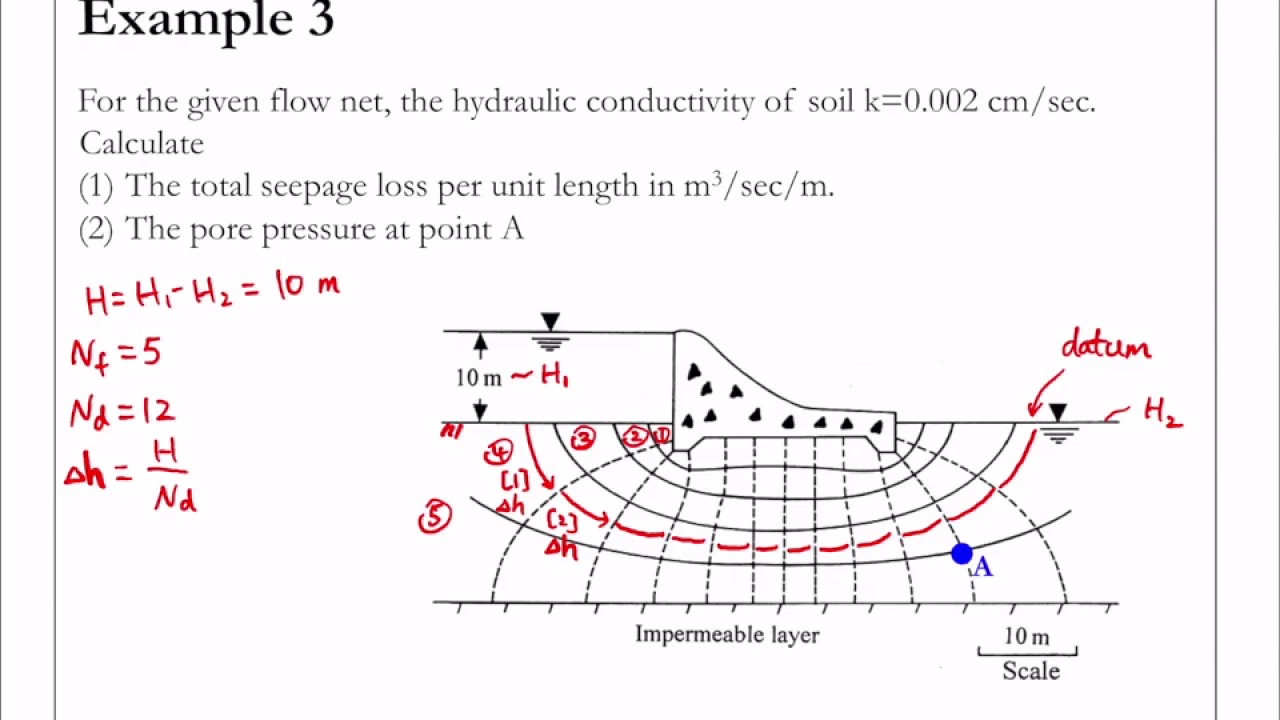
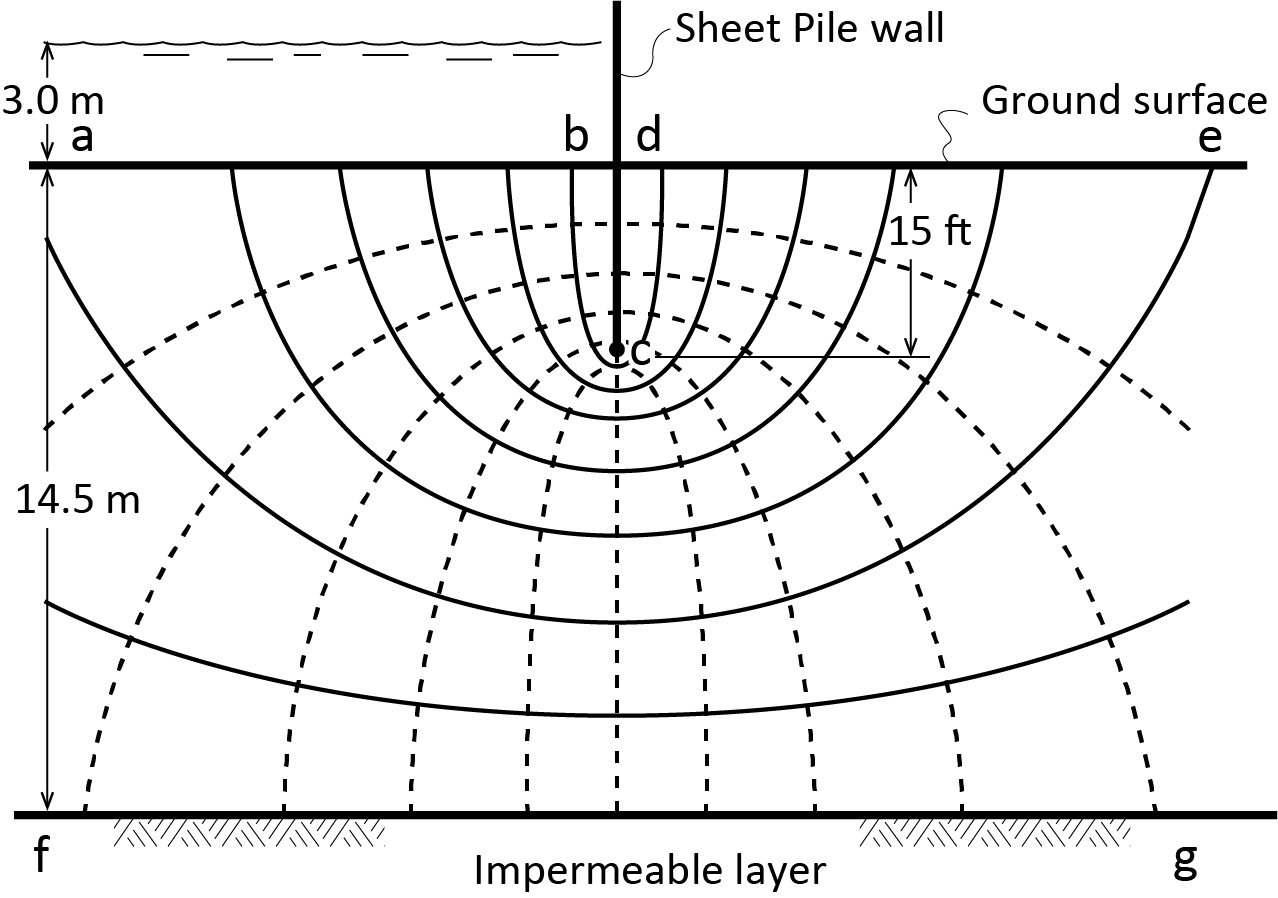
From flow nets:
- Seepage quantity: (per unit width), where is total head loss, flow channels, equipotential drops.
- Critical gradient for piping: (submerged unit weight ratio, ≈1 for many soils).
5. Unsaturated Soil Hydrology: Soil-Water Characteristic Curve (SWCC)
In unsaturated zones, water is held under negative pore pressure (matric suction ).
The Soil-Water Characteristic Curve (SWCC) relates volumetric water content (or degree of saturation ) to matric suction.


Typical S-shaped curve with:
- Air-entry value (suction where desaturation begins)
- Residual saturation (water content below which flow is negligible)
Models like van Genuchten or Fredlund-Xing fit SWCC data, used to predict unsaturated permeability and shear strength.
Practical Applications in Soil Mechanics
- Consolidation: Rate depends on permeability (high → faster drainage).
- Slope Stability and Landslides: Rainfall infiltration increases pore pressure, reducing effective stress.
- Earth Structures: Seepage control in dams using filters, cutoff walls, or drainage.
- Foundation Engineering: Dewatering for excavations; capillary barriers in covers.
- Environmental Geotechnics: Contaminant transport follows similar hydraulic paths.
Laboratory and Field Testing
- Constant/falling head tests for saturated .
- Pressure plate or tempe cells for SWCC.
- In-situ: Pumping tests, borehole permeameters.
Soil hydrology integrates with effective stress principles (high pore pressure reduces strength). Modern analysis uses numerical tools (e.g., SEEP/W, HYDRUS) for transient and unsaturated flow.