Direct Stress and Bending Stress in Civil Engineering
In structural engineering, members like columns and beams experience direct (axial) stress and bending stress, often combined.
1. Direct Stress (Axial Stress)
Direct stress occurs when a load acts along the centroidal axis of a member (centric loading).
- Formula:
- : Axial load (compressive or tensile)
- : Cross-sectional area
- Stress is uniform across the section.
- Common in short columns under pure compression.


2. Bending Stress (Flexural Stress)
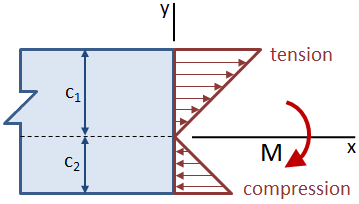
Bending stress arises from pure bending moment (no axial load), varying linearly from zero at the neutral axis (NA) to maximum at extreme fibers.
- Formula:
- : Bending moment
- : Distance from neutral axis
- : Moment of inertia of section
- Or , where is section modulus.
- Compression on one side, tension on the other; neutral axis at zero stress.
3. Combined Direct and Bending Stress
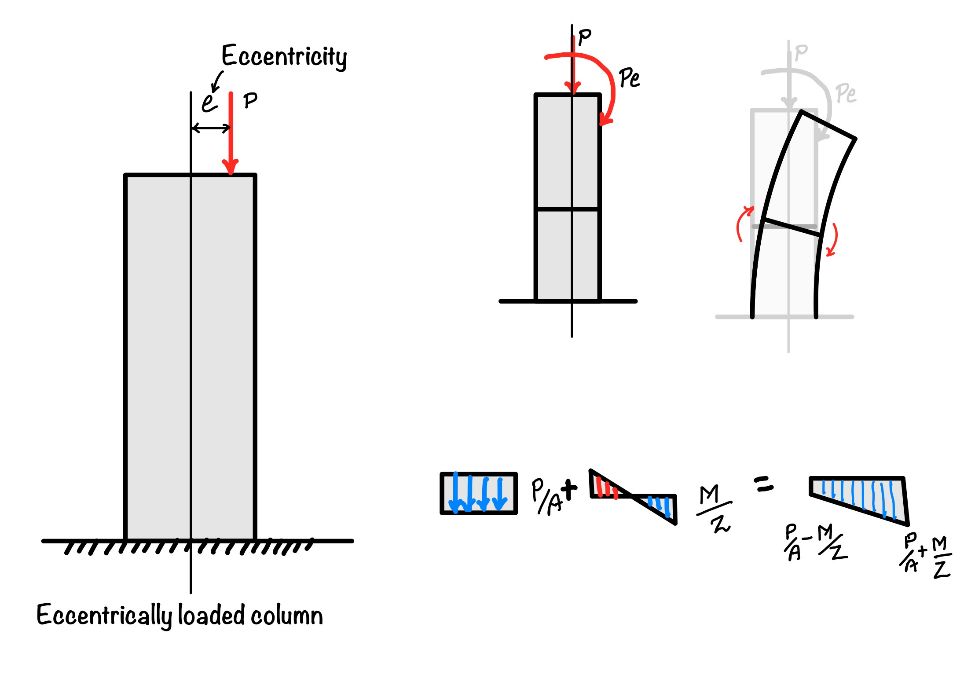
Real structures (e.g., columns with eccentric loads, beam-columns) experience both axial load and bending moment (where is eccentricity).
- Total stress at any point:
- Maximum stress:
- Minimum stress:
- Stress distribution is linear but shifted; neutral axis shifts away from centroid.


Key Concept: Kern of Section
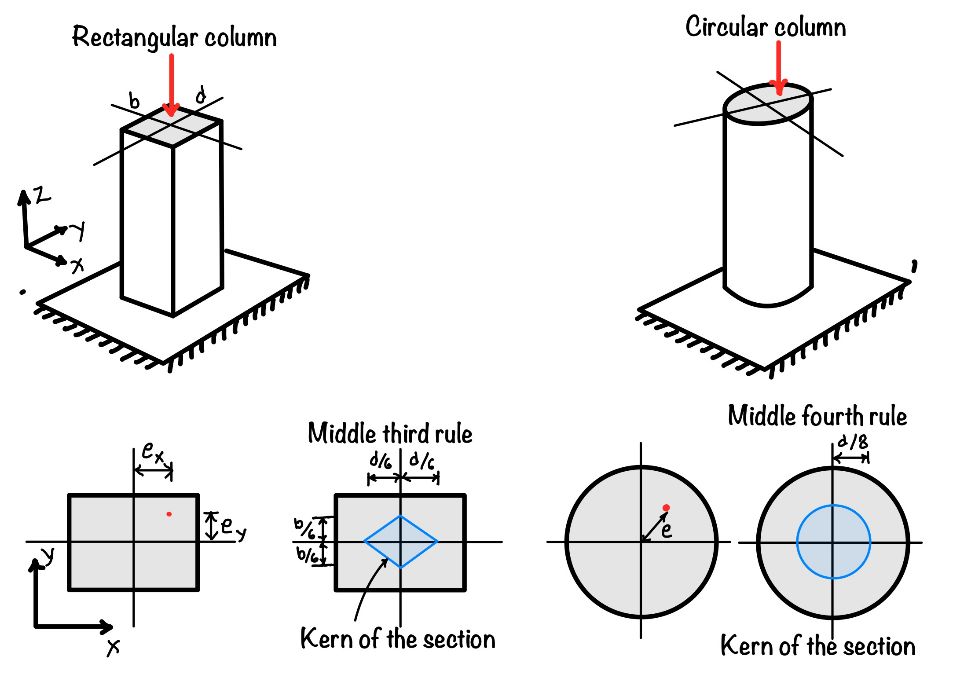
For no tension in masonry/reinforced concrete columns (which resist compression poorly), eccentricity must stay within the kern (middle core).
- Load within kern → All stresses compressive ().
- Limit: (radius of kern).
- For rectangular section: Kern is rhombus with (one axis), (other).
- Circular section: Kern is circle with diameter .
These principles design eccentrically loaded columns, retaining walls, dams, and chimneys in civil engineering. For steel, tension is allowed; for concrete/masonry, limit tension or provide reinforcement.